


HPE ProLiant Gen11 vs Gen12
In a landscape where 78% of businesses struggle to capitalize on AI due to poor data foundations, the choice of compute infrastructure has never been more critical. Hewlett Packard Enterprise (HPE) has responded by evolving its ProLiant family from the versatile Gen11 to the new, AI-optimized Gen12. Both generations are engineered to be secured, optimized, and automated, but they serve different roles in the modern enterprise.
1. HPE ProLiant Gen11: The Foundation for Hybrid Cloud
HPE Gen11 servers were designed to provide a „cloud-operating experience“ for on-premises workloads. They are highly effective for virtualization, software-defined storage, and general-purpose business applications.
Technical Highlights of Gen11:
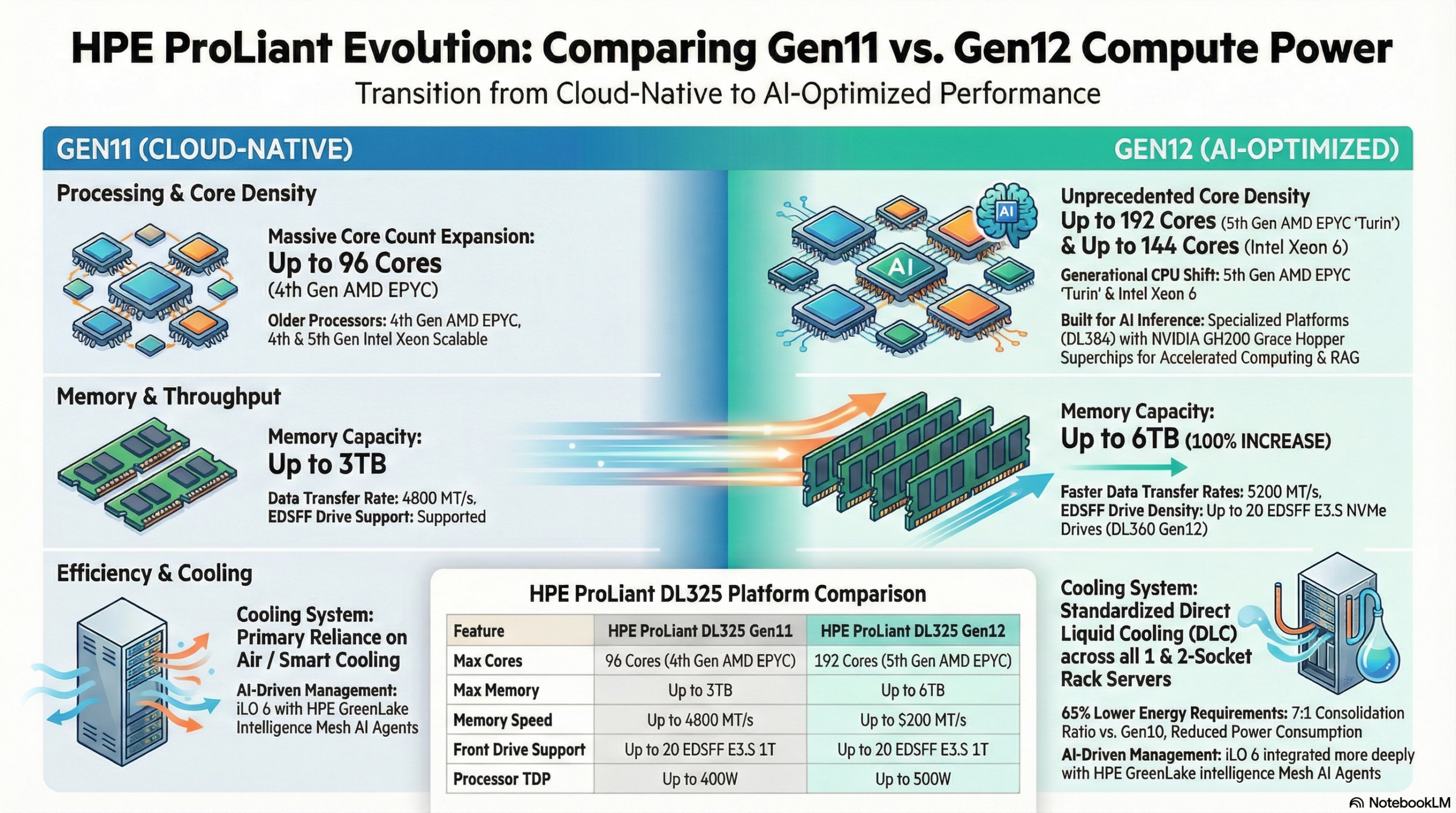
- Processing Power: Supports 4th and 5th Gen Intel® Xeon® Scalable processors (up to 64 cores) and 4th Gen AMD EPYC™ processors (up to 96 cores).
- Memory Efficiency: Features DDR5 memory with speeds up to 4800 MT/s, offering 50% more data bandwidth than previous generations.
- I/O Breakthrough: Fully supports PCIe Gen5, which doubles the I/O bandwidth compared to Gen10, removing bottlenecks for high-speed networking and storage.
- Management: Powered by the iLO 6 ASIC, which integrates with HPE GreenLake for Compute Ops Management to simplify global server footprints.
2. HPE ProLiant Gen12: The AI and Quantum-Ready Powerhouse
The brand-new Gen12 generation is specifically engineered for Extreme AI performance and extreme power efficiency. It is built for a world where air cooling is reaching its limits and data security faces future quantum threats.
Key Advancements in Gen12:
- Massive Core Density: Features the latest Intel® Xeon® 6 processors (up to 144 cores) and 5th Gen AMD EPYC™ (Turin) processors, which reach a staggering 192 cores per socket.
- Next-Gen Memory: Supports DDR5 at speeds up to 6400 MT/s, significantly accelerating data-intensive analytics.
- The iLO 7 Security Vault: Gen12 introduces a 64-bit iLO 7 ASIC with a „Secure Enclave“—a hardware-based vault for encryption keys. It is the industry’s first server line with firmware signing that is resistant to future quantum-computing attacks.
- Advanced Cooling: To handle processors pushing 350W+ and high-wattage GPUs, Gen12 supports Closed-loop Liquid Cooling and Direct Liquid Cooling (DLC).
3. Side-by-Side Comparison: Gen11 vs. Gen12
| Feature | HPE ProLiant Gen11 | HPE ProLiant Gen12 |
|---|---|---|
| Max Core Density | Up to 96 (AMD) / 64 (Intel) | Up to 192 (AMD Turin) / 144 (Intel Xeon 6) |
| Memory Speed | Up to 4800 MT/s | Up to 6400 MT/s |
| Management ASIC | iLO 6 (32-bit) | iLO 7 (64-bit) with Secure Enclave |
| Security Standards | Silicon Root of Trust | FIPS 140-3 Level 3 & Quantum Resistant |
| Performance/Watt | Baseline for Hybrid Cloud | +41% better than legacy systems |
4. Why Modernize? The Most Compelling Case for Refresh
Maintaining legacy servers (Gen8, Gen9, or Gen10) is a costly business risk that can consume up to 70% of IT budgets on maintenance alone.
- Massive Consolidation: Moving from Gen8 to Gen12 allows you to consolidate 26 older servers into a single Gen12 unit.
- Drastic Energy Savings: This consolidation results in up to 84% annual power savings.
- Virtualization Savings: By using high-density Gen12 cores with HPE Morpheus VM Essentials, businesses can slash virtualization licensing costs by up to 90% compared to traditional third-party software.
5. Specialized Models for Every Business Goal
- HPE ProLiant DL320 / DL325: Cost-optimized 1U servers. Best for edge computing and small-to-medium VM environments.
- HPE ProLiant DL360 / DL365: Density-optimized 1U, 2P servers. Perfect for high-performance compute in compact data centers.
- HPE ProLiant DL380 / DL385: Versatile 2U „workhorses“ for mission-critical apps, data analytics, and VDI.
- HPE ProLiant DL384 Gen12: An AI-specialized server featuring the NVIDIA GH200 Grace Hopper™ Superchip for elite fine-tuning and inference.
- HPE ProLiant ML350: A powerful tower solution for SMBs and branch offices requiring rack-level power in a standalone form factor.
Conclusion
Choosing between HPE ProLiant Gen11 and Gen12 depends on your specific workload priorities. While Gen11 remains a robust foundation for standard hybrid cloud tasks, Gen12 is the definitive choice for organizations ready to integrate Generative AI, defend against quantum security threats, or maximize data center sustainability through industry-leading power efficiency.
If you are ready to update your infrastructure and unlock the full potential of your business, contact us at Comstex. We are here to help you design a secure, automated, and future-proof data center environment.



ADDING POWERSHELL SNAP-IN FOR MICROSOFT EXCHANGE 2019 2016 2013
How to add PSSnapin to execute Exchange PowerShell commands? Prerequisites: Can be executed on Exchange Server...
Read More
Omnissa Horizon vs Inuvika OVD — VDI Alternative 2025
For years, Omnissa Horizon (formerly VMware Horizon) has been the established leader in the VDI...
Read More
Cybersecurity in 2025: Protecting Your Business Starts Now
Why 2025 raises the bar Remote and hybrid work, AI-powered attacks, and tighter regulations mean...
Read More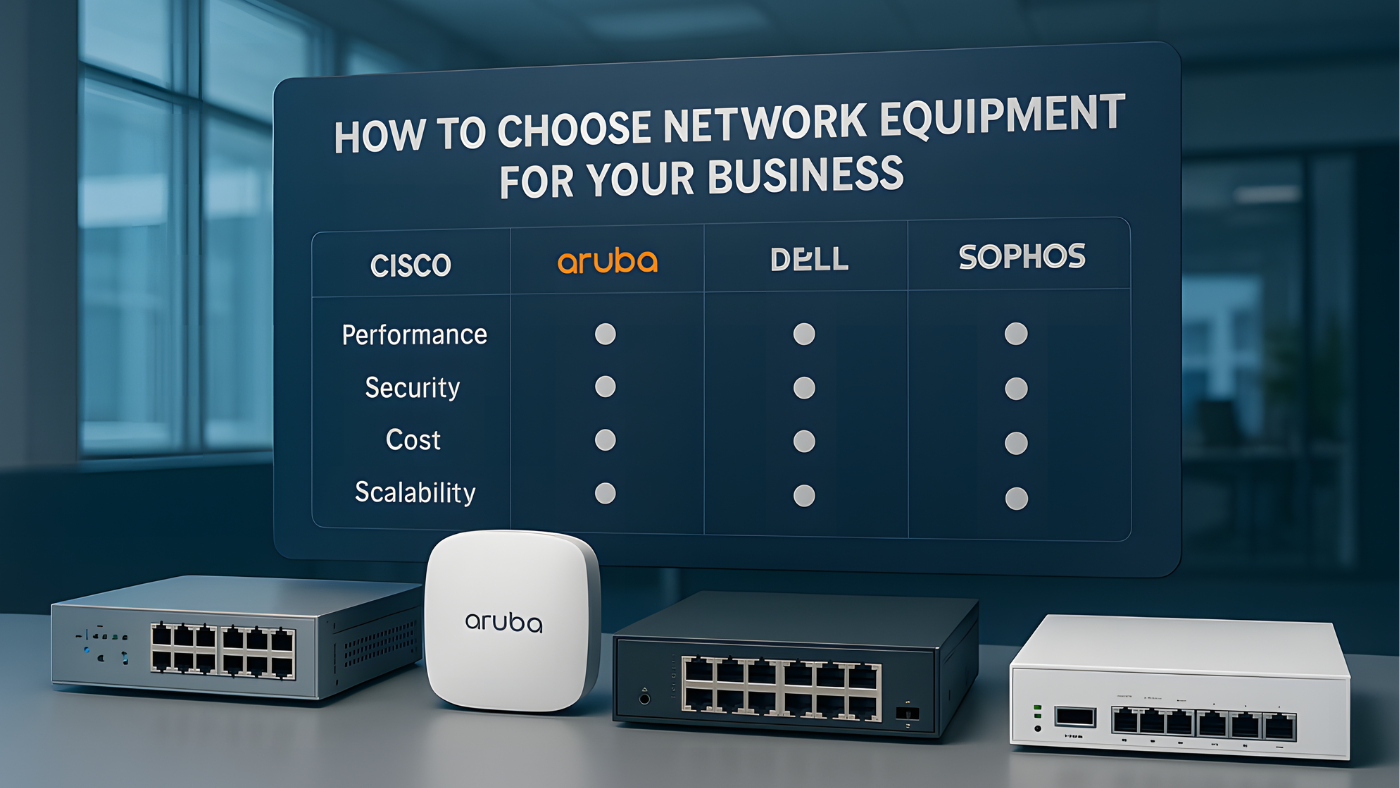
How to Choose Network Equipment for Your Business: Cisco vs. HPE Aruba vs. Dell vs. Sophos
Modern networks carry everything—voice, video, SaaS, cameras, POS—and downtime isn’t an option. In this guide,...
Read More